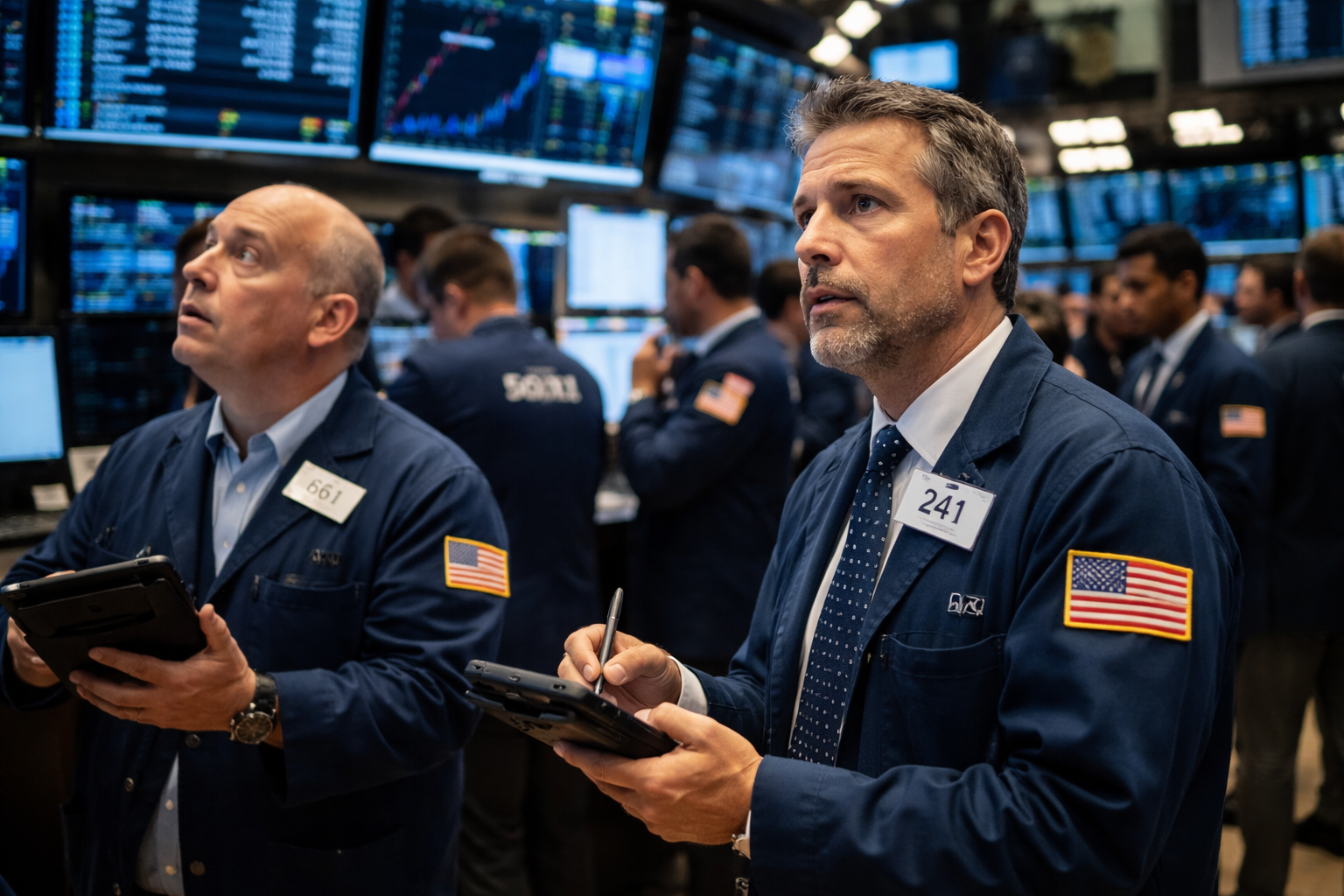
April proved to be an extraordinary month for stock market gains. But not everywhere.
After a storming bounce-back following the selloff in March triggered by the US/Iran war, European and UK stock indices soon lost upside momentum.
Despite the indefinite ceasefire, investors rowed back as the Strait of Hormuz remained effectively closed and controlled by Tehran and energy costs soared.
But it was a different matter for US stock indices, particularly the S&P 500 and the tech-heavy NASDAQ. These rallied 13% and 19% respectively, hitting a succession of record highs.
The small-cap Russell 2000 also added around 13%, hitting its own all-time high before pulling back in the last week of April. The Dow underperformed.
But as the last session of the month unfolded, it too was on course for double-digit gains.
The driving force behind the rally was tech, and in particular, semiconductor stocks and those adjacent to AI development.
The Philadelphia Semiconductor Index (SOX) added around 44% in April.
Within the index, Intel was the star performer, soaring over 120%.
The world’s biggest ever corporation by market capitalisation, NVIDIA, didn’t even make it into the top five gainers in the SOX.
But it still rallied more than 20% over the course of the month. Too far too fast? Maybe.
But this is where the momentum is, and traders just love going with the flow.
Who cares if valuations look excessive historically when the future is unknowable, as is AI’s profit potential?
The apparently unstoppable bull market in chip stocks has persuaded many traders to take chase.
And so far, that has proved to be the right move. Buying the dip has worked since October 2022, so why shouldn’t it work now?
Tech stocks, and perhaps the US in general, are perceived to be largely insulated from the worst effects of the war and the closure of the Strait of Hormuz.
The US is largely self-sufficient in energy, and what it may not have in chemicals for fertilizers and the helium vital for chip makers, it can probably source from its neighbours, Canada and Mexico.
Anyway, wars don’t go on forever, and the crude oil forwards continue to price in significantly lower prices by year-end.
The further one travels into uncharted territory, the more uncertain things can become.
But the US is nothing if not optimistic, and buyers are rarely troubled by the fear that they may be top-ticking the market.
In their favour, the first quarter earnings season has been exceptionally strong.
Of the S&P 500 constituents that have reported so far, over 80% have beaten expectations on earnings and revenues.
In addition, according to FactSet, the S&P 500 year-on-year earnings growth rate is over 15%, and on course for its sixth successive quarter of double-digit growth.
On top of this, profit margins are fat, thanks to the scalability of the US’s tech majors.
Six of the ‘Mag 7’ corporations have now reported, with just NVIDIA still to go, and there was nothing in these to frighten the horses. What’s not to like?
Meanwhile, Jerome Powell has just held his last monetary policy meeting as Chair of the Federal Reserve.
He has said he will remain on the Board of Governors until the Department of Justice concludes its investigation into the overspend during the refurbishment of the Fed’s Marriner S. Eccles building.
This will annoy President Trump, particularly as the appointment of Kevin Warsh as the new Chair means that, with Powell staying on, Stephen Miran, another Trump pick, will have to step down from the Board to make room for Mr Warsh. But that’s politics.
Of more importance is what a Warsh chairmanship may look like. This is far from certain. Mr Warsh is understood to want transparency at the Fed.
But he’s against the central bank providing forward guidance, despite it being helpful in smoothing the way for investors.
He’s also against quantitative easing, viewing it as ‘reverse Robin Hood’, giving to the rich and taking from the poor.
He also told the Senate in a recent appearance that he believes inflation is overstated.
He lacks confidence in Core PCE, the Fed’s preferred inflation measure.
Instead, he wants to put more weight on a trimmed-mean inflation reading, which currently runs at 2.3%, much closer to the Fed’s 2% target than Core PCE, which just came out at 3.2%, its highest reading since November 2023.
Given the division already evident on the rate-setting FOMC, with three members out of twelve wanting to note that the next move could be a hike, and another (Mr Miran) continuing to support a cut, there could be a lot more uncertainty over US interest rates in the coming years.
Will this be enough to see off the bull and wake up the bear from its hibernation?
(This is a fortnightly column by David Morrison. He is a Senior Market Analyst at Trade Nation. Views are his own.)
The post AI rally powers Wall Street higher in April while Europe loses momentum appeared first on Invezz
