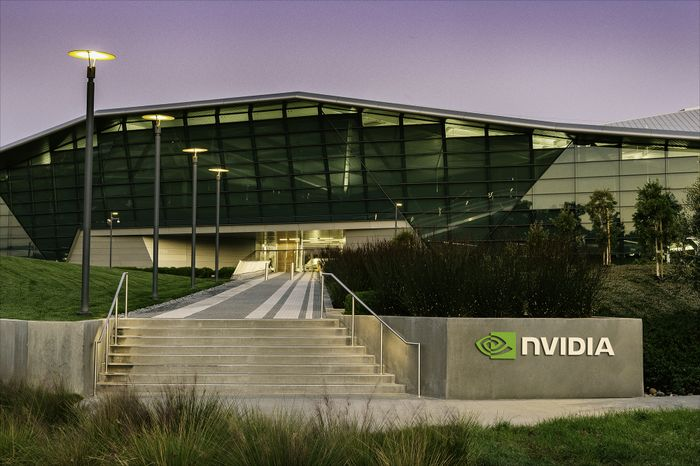
Shares of Nvidia fell roughly 4% in early Thursday trading, even as major technology companies signalled a sharp increase in spending on artificial intelligence infrastructure — a development that would typically benefit the chipmaker.
The decline highlights growing investor caution around the sustainability of Nvidia’s dominance, despite strong demand signals.
Capex surge points to strong AI demand
A wave of updated capital expenditure forecasts from leading technology firms underscored continued momentum in AI infrastructure buildout.
Meta Platforms raised its 2026 capital expenditure outlook by $10 billion to a range of $125 billion to $145 billion, while Alphabet increased its guidance by $5 billion to as much as $190 billion.
Microsoft said its fourth-quarter capex would exceed $40 billion and projected total annual spending of about $190 billion.
Combined with Amazon’s previously announced plans, the four hyperscalers now expect to spend as much as $725 billion in 2026.
Nvidia is a primary beneficiary of this spending, capturing an estimated 90% of AI accelerator demand, with GPUs forming a core component of data centre investments.
Custom chips raise competitive concerns
Despite the strong spending outlook, investor sentiment has been tempered by increasing emphasis on in-house chip development among major technology firms.
Alphabet highlighted growing demand for its Tensor Processing Units (TPUs), which are increasingly positioned as alternatives to third-party GPUs.
The company also said it would begin selling TPUs directly to select customers, expanding their use beyond internal operations.
Custom chips, while typically less powerful than Nvidia’s high-end GPUs, offer cost advantages for specific workloads, potentially reducing reliance on external suppliers.
Supply Constraints Drive Price Surge
At the same time, supply dynamics are tightening in key markets.
Prices for Nvidia’s advanced B300 servers in China have surged to nearly 7 million yuan (approximately $1 million), up from around 4 million yuan late last year, as per a Reuters report.
The increase has been driven by strong demand for AI computing equipment and reduced supply following a crackdown on chip smuggling, which had previously supported a grey market for restricted hardware.
The B300 server is among Nvidia’s most advanced systems for AI workloads, and limited availability has intensified pricing pressures.
Startup investments expand ecosystem
Nvidia is also continuing to expand its presence across the AI ecosystem through strategic investments.
The company’s venture arm, NVentures, has invested in Swedish AI legal technology firm Legora as part of a $50 million extension of its Series D funding round, bringing total funding to $600 million, as per a CNBC report.
The round, which valued Legora at $5.6 billion, also included participation from Atlassian, Adams Street Partners, and Insight.
Such investments reflect Nvidia’s broader strategy of supporting emerging AI companies through both capital and technical expertise, strengthening its position within the ecosystem.
Outlook balances demand and competition
Nvidia’s recent stock movement underscores a shift in investor focus from pure demand growth to questions around competitive positioning and long-term margins.
While hyperscaler spending plans point to sustained demand for AI infrastructure, the rise of custom silicon and evolving supply dynamics are introducing new uncertainties.
The post Why Nvidia stock is crashing 4% after Big Tech earnings appeared first on Invezz
