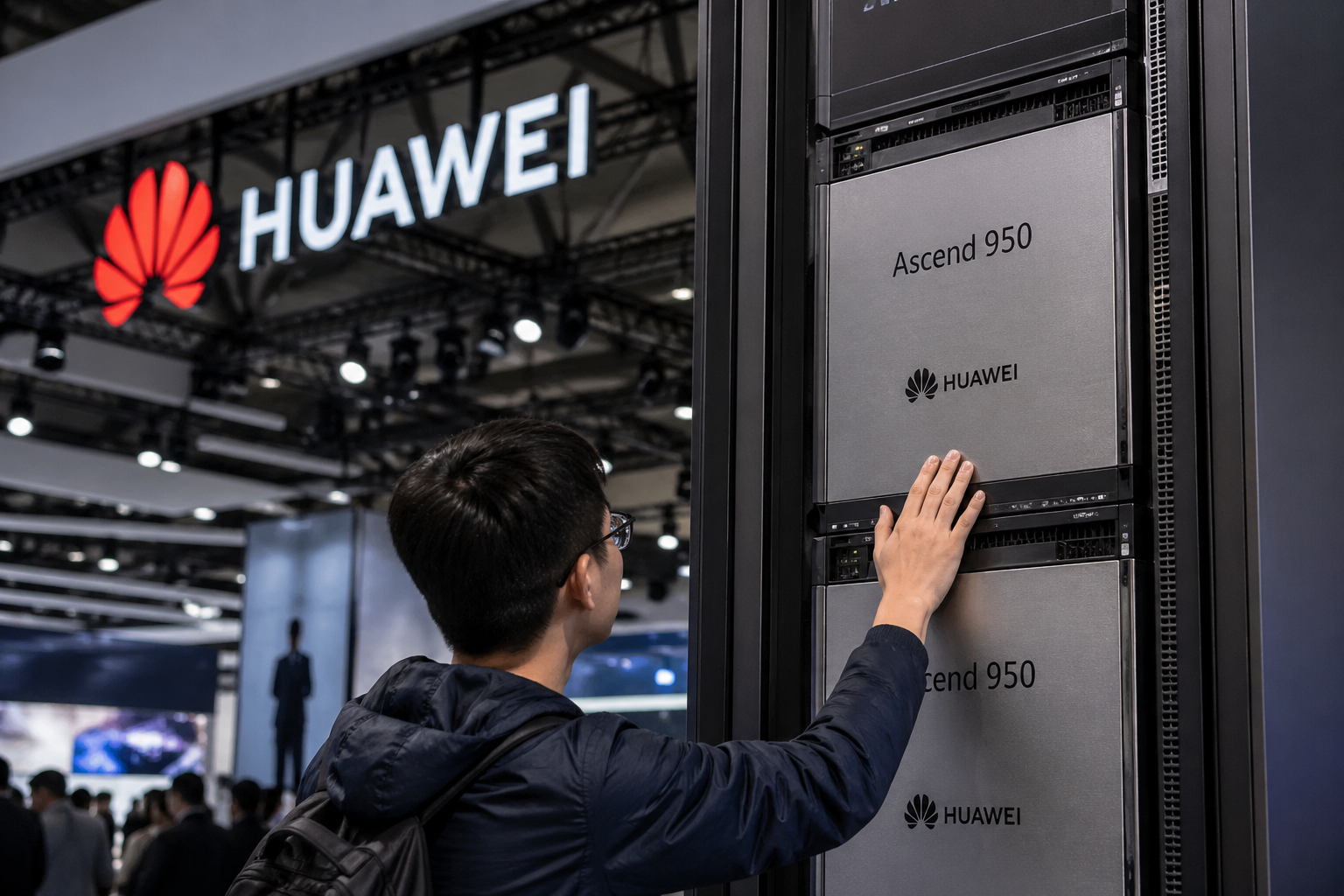
Demand for Huawei’s Ascend 950 artificial intelligence chips has surged following the release of DeepSeek’s V4 model, which runs on the Shenzhen-based company’s hardware, as per a Reuters report.
Major Chinese internet companies, including ByteDance, Tencent, and Alibaba, are actively reaching out to Huawei to secure new chip orders, the sources told Reuters.
The discussions are linked to procurement efforts following the model’s release.
Companies focused on cloud computing and GPU rental services are also moving quickly to place orders, according to two sources cited in the Reuters report, although specific firms were not identified.
Performance gap and regulatory landscape
Huawei’s Ascend 950PR chip is said to significantly outperform Nvidia’s H20 chip, which had been the most advanced processor Nvidia was allowed to sell in China before Beijing blocked its import last year.
However, it still trails Nvidia’s more advanced H200 chip.
Despite regulatory approvals from both the United States and China, shipments of the H200 to China have not begun.
Ongoing disagreements between Beijing and Washington over sales conditions have delayed deployment, creating an opening for Huawei to expand its presence in the semiconductor market.
The 950PR marks a turning point for Huawei after years of struggling to secure large-scale orders from domestic technology firms.
Earlier customer testing was successful, and companies such as ByteDance and Alibaba began planning orders after receiving samples in January,.
DeepSeek V4 fuels domestic AI ecosystem
The release of DeepSeek V4 has significantly boosted demand for domestic AI hardware, reflecting the impact of US export restrictions on access to Nvidia’s top-tier chips.
DeepSeek’s decision to optimise its model specifically for Huawei hardware signals a shift towards China’s homegrown semiconductor ecosystem.
Last week, Huawei stated that its Ascend SuperNode infrastructure, built on the 950 series chips, would fully support DeepSeek V4 models.
The company added that its entire product line had been adapted for V4 inference, referring to the process of executing AI tasks using trained models.
Among Chinese chipmakers, Huawei’s Ascend 950 series is currently the only domestic solution capable of supporting compressed numerical processing techniques, allowing higher computational efficiency at lower costs, as highlighted in the Reuters report.
Cloud providers have moved quickly to deploy the model.
Alibaba Cloud’s Bailian platform made DeepSeek V4 available on the day of its release, offering both V4-Pro and V4-Flash versions at official pricing.
Tencent Cloud also launched preview services on its TokenHub platform the same day, deploying the model across domestic infrastructure and its Singapore gateway.
Supply constraints likely to persist
The rapid rollout across cloud platforms has expanded access to millions of users and developers, increasing demand for AI processing capacity and the chips that power it.
DeepSeek is offering developers a 75% discount on V4 until May 5 and indicated that pricing for V4-Pro could decline in the second half of 2026 once Huawei’s supernodes ship at scale.
However, the company also acknowledged that supply constraints will persist until production ramps up.
The V4 models include two versions V4-Pro with 1.6 trillion parameters and V4-Flash with 284 billion parameters both supporting a one-million-token context window.
The models are released under the MIT open-source licence, allowing broad commercial use.
Huawei is planning to ship approximately 750,000 units of the 950PR chip this year, with mass production beginning in April and full-scale shipments expected in the second half of 2026, as mentioned in a Reuters report.
However, output is likely to remain below demand due to US restrictions on advanced chipmaking equipment, which limit China’s manufacturing capabilities.
The post Huawei Ascend 950 chip demand surges after DeepSeek V4 launch appeared first on Invezz
