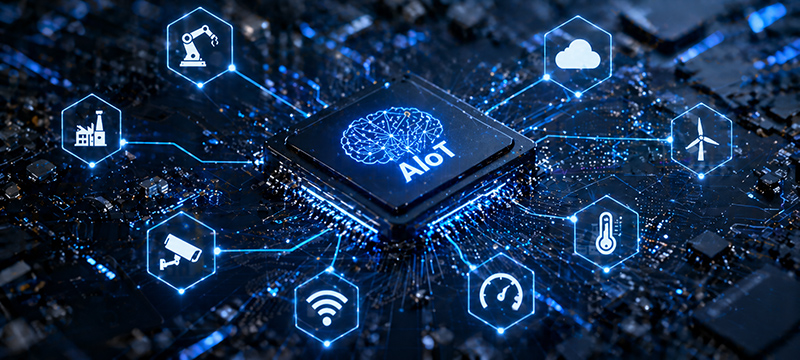
Artificial Intelligence is increasingly intersecting with connected systems, reshaping how data is processed and acted upon across industries. In this context, AIoT — the convergence of Artificial Intelligence and the Internet of Things — is emerging as a critical architectural paradigm for turning raw device data into operational intelligence.
Rather than simply connecting devices and collecting telemetry, AIoT focuses on embedding intelligence across the data lifecycle, from edge devices to cloud platforms. For IoT decision-makers and engineers, understanding how AIoT works is becoming essential to design scalable, efficient, and autonomous systems.
Key Takeaways
AIoT combines IoT connectivity with AI-driven analytics to enable real-time, autonomous decision-making.
Edge computing plays a central role in reducing latency and optimizing bandwidth usage in AIoT architectures.
AIoT is widely deployed across industrial, logistics, energy, and smart city environments.
Data quality, interoperability, and scalability remain key challenges in AIoT implementations.
The ecosystem spans hardware, connectivity, platforms, and AI frameworks, requiring cross-domain expertise.
What is AIoT?
AIoT refers to the integration of Artificial Intelligence (AI) technologies with Internet of Things (IoT) infrastructures to enable intelligent data processing, automated decision-making, and adaptive system behavior. It transforms IoT systems from passive data collection networks into active, context-aware systems capable of optimizing operations in real time.
Within the broader IoT ecosystem, AIoT acts as a layer of intelligence that extracts value from the vast volumes of data generated by connected devices. While traditional IoT architectures focus on connectivity and data aggregation, AIoT introduces machine learning models, inference engines, and predictive analytics to interpret this data and trigger actions.
This shift is particularly relevant in environments where latency, scalability, and operational efficiency are critical. By distributing intelligence across edge and cloud layers, AIoT enables faster decision cycles and reduces reliance on centralized processing.
How AIoT works
AIoT systems are built on a multi-layered architecture combining sensing, connectivity, data processing, and intelligence. At the foundation are IoT devices equipped with sensors that collect environmental, operational, or behavioral data.
This data is transmitted through communication networks such as cellular IoT (LTE-M, NB-IoT), LPWAN technologies (LoRaWAN, Sigfox), or short-range protocols (Wi-Fi, Bluetooth). Once transmitted, the data can be processed at different levels depending on system requirements.
Edge computing is a key component of AIoT architectures. Instead of sending all data to centralized cloud platforms, edge devices or gateways perform local processing using embedded AI models. This enables:
Low-latency decision-making
Reduced bandwidth consumption
Improved data privacy
At the cloud level, more complex analytics and model training processes take place. Machine learning models are trained using historical datasets and then deployed back to edge devices for inference.
The typical AIoT data pipeline includes:
Data acquisition from sensors
Preprocessing and filtering at the edge
Transmission to cloud or edge servers
Model training and optimization
Inference and automated action triggering
This distributed architecture allows AIoT systems to balance performance, scalability, and cost.
Key technologies and standards
AIoT relies on a combination of hardware, software, and communication technologies. Key components include:
Connectivity technologies: LTE-M, NB-IoT, 5G, LoRaWAN, Wi-Fi, Bluetooth Low Energy
Edge computing platforms: gateways, embedded processors, AI accelerators
Cloud platforms: data lakes, analytics engines, AI model training environments
AI frameworks: TensorFlow Lite, PyTorch Mobile, ONNX for edge inference
Data protocols: MQTT, CoAP, HTTP for device-to-cloud communication
Device management standards: LwM2M for lifecycle and firmware updates
Interoperability remains a central issue. Many AIoT deployments must integrate heterogeneous devices, networks, and software stacks. Standardization efforts aim to address fragmentation but are still evolving.
Hardware constraints also influence design choices. Edge AI models must be optimized for limited processing power, memory, and energy consumption, particularly in battery-operated devices.
Main IoT use cases
AIoT is being deployed across a wide range of industries where real-time insights and automation can improve operational efficiency.
Industrial IoT
Predictive maintenance based on sensor data and anomaly detection
Quality inspection using computer vision at the edge
Process optimization through real-time analytics
Logistics and supply chain
Dynamic route optimization using real-time traffic and asset data
Condition monitoring of goods (temperature, humidity)
Warehouse automation with AI-enabled robotics
Smart cities
Traffic management systems using real-time sensor and camera data
Waste management optimization based on fill-level prediction
Energy-efficient street lighting with adaptive control
Energy and utilities
Grid balancing using predictive analytics
Smart metering with consumption forecasting
Fault detection in distribution networks
Healthcare
Remote patient monitoring with anomaly detection
Wearable devices providing real-time health insights
Hospital asset tracking and workflow optimization
These use cases illustrate how AIoT moves beyond data collection to enable automated and context-aware decision-making.
Benefits and limitations
AIoT offers several advantages compared to traditional IoT systems:
Improved efficiency: automation reduces manual intervention
Faster decision-making: edge inference minimizes latency
Enhanced scalability: distributed processing reduces cloud dependency
Better resource optimization: predictive analytics improve asset utilization
However, AIoT deployments also face significant challenges:
Data quality: inaccurate or incomplete data can degrade model performance
Complexity: integrating AI models into IoT systems requires specialized expertise
Security risks: increased attack surface across devices and networks
Power constraints: running AI models on edge devices can increase energy consumption
Interoperability issues: fragmented standards complicate integration
These trade-offs must be carefully managed when designing AIoT architectures.
Market landscape and ecosystem
The AIoT ecosystem spans multiple layers of the technology stack, involving a wide range of stakeholders.
Device manufacturers: sensors, modules, and embedded systems providers
Connectivity providers: mobile network operators and LPWAN networks
Platform vendors: cloud providers offering IoT and AI services
Software developers: AI model development and integration tools
System integrators: deployment and customization of end-to-end solutions
Collaboration across these layers is essential. AIoT projects often require integration between hardware engineering, network design, and data science capabilities.
Another defining characteristic of the market is the shift toward vertical-specific solutions. Rather than generic platforms, many deployments are tailored to industry-specific requirements such as industrial automation, smart mobility, or energy management.
Future outlook
AIoT is expected to evolve alongside advances in edge computing, 5G connectivity, and AI model optimization. Several trends are shaping its future development.
Increased adoption of edge AI to support real-time applications
Integration of generative AI for advanced analytics and automation
Growth of digital twins combining IoT data with simulation models
Expansion of private 5G networks for industrial AIoT deployments
Improved hardware accelerators for low-power AI processing
At the same time, regulatory and security considerations will play a growing role. Data governance, privacy, and AI transparency are becoming central concerns in large-scale deployments.
The long-term trajectory suggests a gradual shift from connected systems to autonomous systems capable of self-optimization and adaptation.
Frequently Asked Questions
What is the difference between IoT and AIoT?
IoT focuses on connecting devices and collecting data, while AIoT adds intelligence through AI models that analyze data and enable automated decision-making.
Why is edge computing important in AIoT?
Edge computing reduces latency and bandwidth usage by processing data closer to the source, enabling real-time responses in AIoT systems.
What industries benefit most from AIoT?
Industries such as manufacturing, logistics, energy, healthcare, and smart cities benefit significantly due to their need for real-time monitoring and automation.
What are the main challenges of AIoT?
Key challenges include data quality, system complexity, security risks, interoperability issues, and power constraints for edge devices.
How does AIoT improve operational efficiency?
AIoT enables predictive analytics and automation, allowing organizations to optimize processes, reduce downtime, and improve resource utilization.
Related IoT topics
Edge Computing for IoT
Edge AI for IoT
LPWAN Technologies
Digital Twins
Predictive Maintenance
The post AIoT: From Connected Data to Intelligent Automation Across Industries appeared first on IoT Business News.
