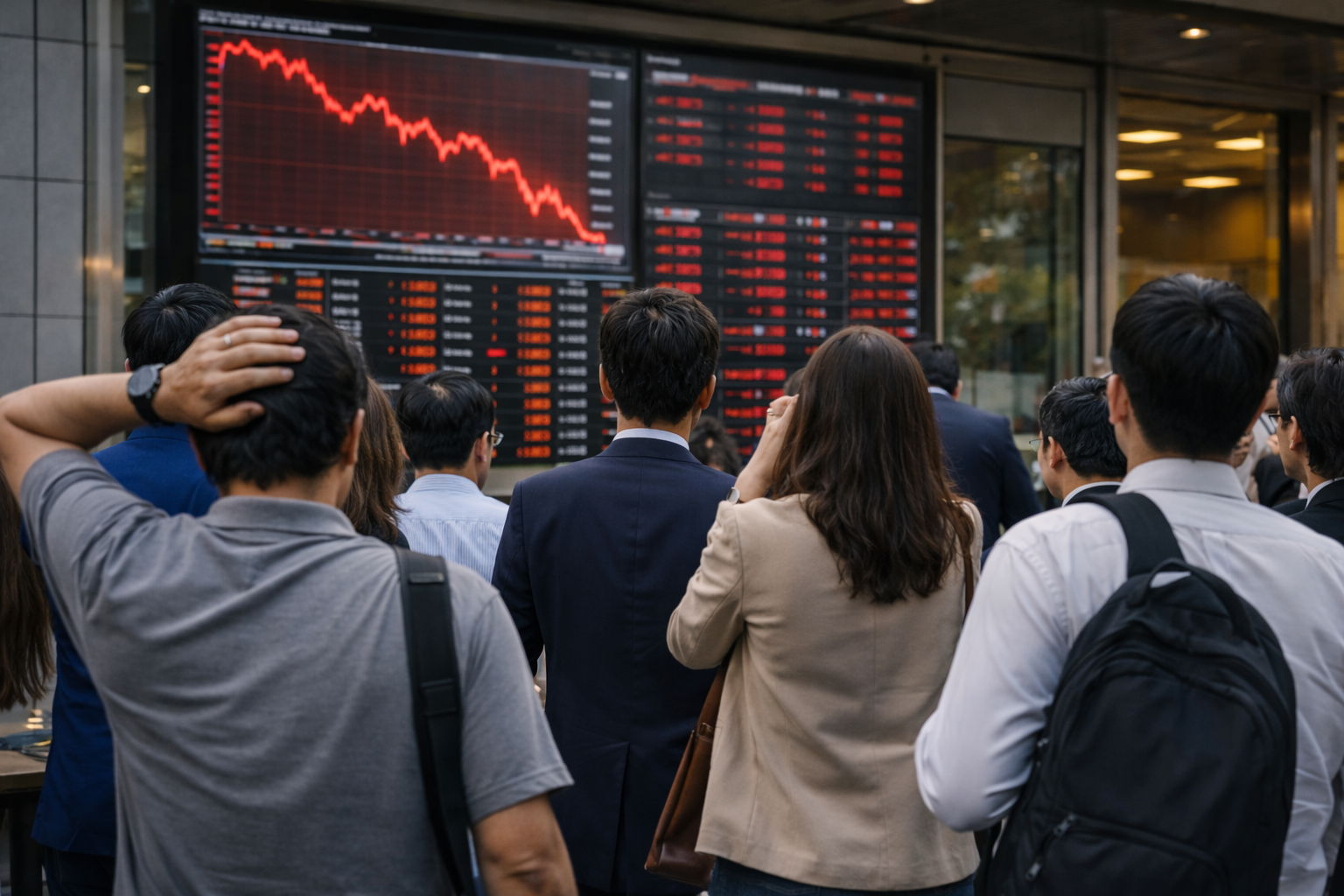
Asian markets opened on the back foot on Thursday, as investors across the region absorbed the fallout from Donald Trump’s overnight address.
In his address to the American people, the US President vowed to hit Iran “extremely hard” in the coming two to three weeks, remarks that infused a fresh bout of caution among investors.
The speech failed to offer the clarity markets were hoping for on the path to de-escalation, the status of the Strait of Hormuz, or the outlook for energy supplies.
The result was expected, as stocks plunged, crude surged, and investors returned to a defensive mode.
Asian markets open lower
The weakness was broad across Asia, though the intensity varied from market to market.
Japan’s Nikkei 225 fell 1.4% at the open, while the broader Topix lost 0.94%.
South Korea saw the sharpest move, with the Kospi down 2.82% and the small-cap Kosdaq off 3%.
Australia’s S&P/ASX 200, which initially opened in positive territory, later turned 0.48% lower.
In Greater China, Hong Kong’s Hang Seng opened down 0.5%, while mainland China’s CSI 300 was little changed.
The pattern suggested that the pullback is cyclical and from risk-sensitive assets rather than a uniform panic selloff.
South Korea, with its heavy exposure to export and technology names, appeared most vulnerable to the shift in sentiment.
Japan also reflected the pressure of a stronger defensive tone in global markets.
By contrast, China was steadier, offering a reminder that not every market in Asia was reacting with the same force.
Trump said the conflict with Iran was “nearing completion,” but he also made clear that the US would continue hitting Iran “extremely hard” in the coming weeks.
For investors, that was not the clean reassurance they had hoped for after a volatile stretch in global trading.
Instead of a clearer endgame, the address left open the possibility of further escalation.
That mattered because markets had already spent the previous session leaning toward a more hopeful interpretation of the conflict.
Oil prices rebound, keeping pressure on sentiment
Oil was the clearest transmission channel into Asian equities.
After the speech, Brent crude climbed roughly 5% to around $106 a barrel, while US West Texas Intermediate rose more than 4% to just above $104.
Those moves reversed earlier weakness and put energy risk back at the centre of the market narrative.
The surge in crude prices matters directly for Asia’s trade-heavy economies.
Higher crude prices raise import bills, add to inflation pressure, squeeze corporate margins, and threaten consumer demand.
They also darken the outlook for central banks that had been hoping to manage softer growth without another external price shock.
The post Kospi slides 2.8%, Nikkei 1.4% as Trump Iran warning jolts Asian markets appeared first on Invezz
