Where occupational licensing exceeds genuine public safety needs, it substitutes centralized judgment and political privilege for the preferences of consumers and workers.
Introduction: Individual Rights and the Public Good
The tension between individual rights and the common good is as old as political theory itself. One area in which this question arises is that of occupational licensing. To what extent can (or should) the government require a license to engage in commercial activity? What are the public safety arguments for that occupational licensing? And what forms can (or should) that occupational licensing take, from fees to examinations, or outside certifications?
To address these questions, this Explainer begins with examples and history. It continues with basic economic analysis, political economy, and constitutional considerations. It concludes with possible alternatives.
1. Examples
Today, an estimated 25 percent to 30 percent of Americans require a license – permission from the government (typically the state, rather than federal) – to engage in their occupation. Examples range from the unobjectionable to the eyebrow-raising.
The Institute for Justice has cataloged 2,749 licenses across the 50 states and the District of Columbia. On average, licenses require 362 days of education, at least one exam, and $295 in fees.
Individual states license anywhere from 26 occupations (Wyoming) to 77 (Louisiana).
Graduation from an accredited medical school is insufficient to practice medicine. Physicians must obtain permission from a state licensing board.
Throughout the US, lawyers must, after successfully completing three years at an accredited law school, pass the state bar examination. In some states, the administering state bar association is a public corporation or a state agency; in other states, the bar is a voluntary association (but one that has a state-granted monopoly to license lawyers to practice in that state). The fees for sitting the exam and obtaining the license range from $500 to $3,000.
In Nevada, would-be travel guides require 733 days of training and a $1,500 licensing fee.
The State of Michigan requires 1,460 days of education and training to become an athletic trainer, but only 26 days to become an Emergency Medical Technician (EMT); the national average is about 150 hours of training (19 eight-hour days), plus an examination for basic EMTs, up to 1,500 hours in a two-year program to become a Paramedic.
For a barber’s license, the state licensing burden ranges from 68 to 896 days, plus an exam and a mandatory fee of $25 to $500.
The District of Columbia government requires anybody who wishes to provide childcare to hold an associate’s degree in an early childhood field or ten years of experience.
In Louisiana, it is illegal to sell flowers without passing a florist’s examination and obtaining a license (this is beyond the operating license required of all businesses).
A few other examples of regulated occupations that require a license: ballroom dance instructors, cat groomers, fortune tellers, home entertainment installers, movie projectionists, taxi drivers, and whitewater rafting guides.
Finally, university professors or other professionals are not allowed to teach high school classes in their specialties without completing student-teaching requirements, passing the state certification exam, and obtaining a state license (details vary by state; the process takes an average of one to two years).
2. History
While the scale of occupational licensing today — affecting between one-quarter and one-third of all working Americans — is new, the concept of worker certification is not. In many ways, the medieval order, with its fixed social stations and occupations determined by birth, functioned as a form of occupational licensing. Noble vassals were bound to serve their suzerain overlords (in a chain going up to the monarch) and protect their peasants; peasants were bound to work the noble’s land, and could not leave the domain or change occupation without permission. Guilds emerged in the mid- to late Middle Ages as a challenge to medieval stasis and aristocratic privilege; however, in their efforts to protect their members, they also excluded outsiders by imposing rigid and lengthy apprenticeships.
Occupational licensing was present in the American colonies, from bakers and ferry operators to peddlers and lawyers. From the Revolution through the Progressive Era, occupational licensing existed at the state level but was not widespread, and was contested by discontented outsiders trying to practice their crafts. The landmark Supreme Court case, Dent v. West Virginia 129 US 114 (1889) addressed the constitutionality of state requirements for medical doctors. The Court ruled that there was a balancing act between individual economic rights and the public interest. On the one hand, the Court held that individuals possess a prima facie right to pursue a peaceful occupation and that the state may not impose arbitrary requirements that would deprive them of that right. On the other hand, the Court ruled that the state has a legitimate interest in promoting public health and safety – and therefore the authority to impose reasonable regulation and restrictions on certain occupations. In sum, the Court upheld the states’ constitutional authority, under their police powers, to impose licensing requirements so long as those requirements are deemed reasonable.
The Progressive era marked the beginnings of widespread occupational licensing, as the state took an increasingly active role in economic regulation, and courts began to downplay individual economic rights in favor of the state’s interest in advancing Progressive goals (see section five below). By 1950, about five percent of American workers required an occupational license to practice their trades. The expansion continued over the next 80 years, as technological advances and increased specialization made it increasingly difficult for consumers to judge for themselves the quality of practitioners (or so went the regulatory logic). This growth in occupational licensing was part of a broader expansion in regulation: today, American consumers and businesses spend about 10 percent of GDP every year to comply with federal regulations, not including state regulations, and 25 to 30 percent of Americans require state licensing to engage in their occupation.
3. A Microeconomic Analysis
From a political economy perspective, occupational licensing goes to the heart of the social contract, balancing individual rights with the state’s interest in regulating individual behavior to advance the public good (and, of course, raising the related question of the state’s ability to do so, per the Austrian critique; see section four). From a microeconomic perspective, one can examine demand-side versus supply-side analyses of occupational licensing. In both cases, the central question is its effect on public welfare.[1]
One theory of occupational licensing emphasizes the demand side (we might call this the “public interest” perspective). According to this approach, there is high potential for market failure – markets generally allocate scarce resources fairly well, and competition provides some discipline and quality control, but they can break down in certain cases.[2] For example, market concentration can limit the benefits of competition; public goods such as education may be underprovided because their social benefit exceeds the private benefit, leading to underinvestment; and pollution may be overproduced because the social cost exceeds the private cost, giving firms an incentive to ignore it.
In the case of occupational licensing, the argument is that information asymmetries exist: consumers often know very little about professionals, especially in highly specialized or technical markets, and professionals can exploit that to cheat consumers. The state can overcome the information asymmetry by requiring an occupational license, effectively certifying professionals for consumer protection.[3] According to this theory, there is an additional benefit: the effort and skill required for licensing will increase the overall quality of professionals, both directly (by keeping out lower-quality professionals) and indirectly (because the higher wages from the barrier to entry reward quality, and provide an incentive for greater investment in human capital). For these reasons, occupational licensing is considered to increase aggregate welfare.
An alternate theory emphasizes the supply side, and is closely linked to Public Choice theory. From this perspective, occupational licensing is primarily driven by producers seeking to reduce competition by raising barriers to entry. This restriction diminishes threats from potential
entrants and raises wages for incumbents.[4] In more technical terms, the political process concentrates benefits on a small group of policy beneficiaries while diffusing costs across the broad, unorganized population of consumers, who face higher prices but cannot easily identify the causes. Those in protected groups have an incentive to lobby for continued benefits, and politicians are responsive to this organized and visible constituency. In contrast, the costs are diffuse — borne by consumers and professionals excluded from the market because they lack a license — so there is little incentive for political organization, and politicians remain largely unresponsive to these unorganized groups.[5]
What are we to make of these competing claims? As the next two sections will show, the evidence invites skepticism toward “common good” arguments. Moreover, there are serious doubts about the state’s knowledge to regulate an occupation and about its motivations, given the dynamics of concentrated benefits and diffuse costs.
Indeed, the supply-side theory highlights serious flaws in the demand-side argument. First, occupational licensing drives up prices. It decreases competition. And it leads to market inefficiencies, such as forum-shopping (whereby states attract professionals through higher salaries or lower regulatory burdens) or decreased economic mobility (as professionals licensed in one state will face higher transaction costs, in the form of repeat licensing, if they wish to move to another state.) It’s hard to see how any of these outcomes benefit consumers.
Second, occupational licensing appears to function as a polite form of incumbent protection. A recent Cato Institute report finds that “data on state associations for nine major occupations reveal that the probability of an occupation becoming regulated increased by 20 percentage points within five years of… [the] founding in that state [of a trade association representing that occupation].” Further supporting the supply-side, or lobbying, thesis, the Institute for Justice finds that licensing burdens disproportionately affect low-income occupations.
Third, a study by the Center for Growth and Opportunity at Utah State University identifies three counter-arguments to the public interest (consumer protection) approach: 1) technological advances over the past 30 years have reduced information asymmetries, so, if the consumer protectiontion theory is correct, we should see a decline — not a rise — in occupa-tional licensing (see the discussion of alternatives below); 2) consumer protection cannot explain the wide variation in licensing across states; and 3) consumers do not lobby for occupational licensing, but professional associations do, lending credence to the theory that licensing is motivated more by incumbent protection than by consumer protection.
4. Political Economy
The analysis in the previous section relies on traditional microeconomics — specifically welfare economics, which studies the overall effects of policies on the general welfare. There is another approach to evaluating occupational licensing: political economy, and in particular, an economic theory of the state.
The classical liberal umbrella of those concerned with individual rights and liberty contains three schools of thought, writ large: anarcho-capitalists, minarchists (or minimal state theorists), and super-minimalists (for lack of a more elegant term). All three are, when generously interpreted, genuinely concerned with advancing liberty, individual rights, and the general welfare. But they differ sharply on methods.
While political theory discussions are often divorced from economics, they are relevant here for illustrating the role of the state and the balance between the public interest and individual rights.
For the anarcho-capitalists (e.g., Lysander Spooner and Murray Rothbard), the state is inherently predatory and immoral, organizing human relations through violence. Moreover, the state is also unnecessary: markets can provide what individuals can’t produce on their own, including security and justice through private means, rather than distortionary taxation. Where the market falls short, civil society can fill the gaps — for example, for charity or education without taxation and the rent-seeking problems of state action. An anarcho-capitalist, then, would dispense entirely with occupational licensing. Market forces would handle consumer protection: bad professionals would receive bad reviews and lose customers. Professionals would compete on reputation and transparency, or seek voluntary third-party certification, while robust insurance markets would provide coverage against misconduct.
The minarchists (also called minimal state theorists or libertarians, in the tradition of Ludwig von Mises and Ayn Rand) worry that anarcho-capitalism is a lovely idea, but would quickly devolve into conflict between competing protective agencies. Instead, they propose a neutral, constitutionally constrained, minimal state responsible only for basic functions of security and rights-protection: police, the courts, and national defense. For consumer protection, a minarchist state would rely on the same voluntary mechanisms as anarcho-capitalism, supplemented by tort law and contractual violations litigated in the courts, as well as the public prosecution of fraud.
Super-minimalists share the classical liberal concern with individual rights and constitutional constraints on the state, but they recognize a limited role for the state in remedying market failures – always with great caution and within strict constitutional limits. When collective action is cheaper or more efficient than private action, the state can provide public goods; this is known as the “productive” state. Far from giving carte blanche to the state, as Progressivism seeks to do, super-minimalists are concerned with the fragile balance of the productive state and preventing it from lapsing into a predatory state or the redistributive tendencies of Progressivism or socialism.
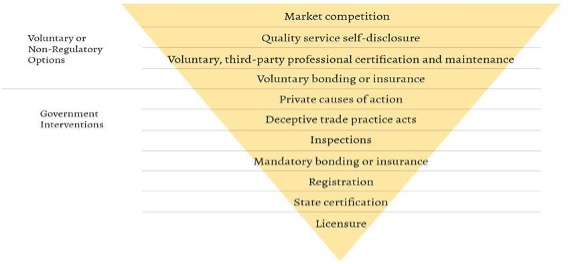
Twentieth-century champions of liberty such as F.A. Hayek, Milton Friedman, and James M. Buchanan – who were all deeply concerned with individual rights and the rule of law – called for public support (if not provision) of such things as primary education, mosquito control, the earned-income tax credit, or even a minimum basic income. Super-minimalists would, naturally, rely first on voluntary market and reputational mechanisms; second, on legal action by the state to prosecute contract violations and fraud; and only then, as a last resort, on positive state action to protect consumers in cases of information asymmetry. They are careful to avoid policies that encourage incumbent protection or rent-seeking. Their approach involves gradually intrusive levels of enforcement: mandatory bonding or insurance could be a first step, followed by mandatory registration or disclosure, and only in extreme cases would they propose occupational licensing — and only for the most critical occupations.
5. Public Good and Individual Rights: A Constitutional Approach
The tension between individual rights and the state’s police powers to advance the public good is not just the playground of political theorists. In the American constitutional experiment, the courts have grappled with the balance between true state advancement of the public welfare and naked rent-seeking.
In Nebbia v. New York, 291 US 502 (1934), the United States Supreme Court upheld a New York State price control law, ruling that economic rights fall below political rights – and that the state faced a lower burden for curbing the former than the latter, in the name of advancing the public interest. As the Court explained, “Rational basis review, which is used for economic regulations, requires that the law is not unreasonable or arbitrary and also that there is a reasonable relationship between the law and the interest that it serves.” The Court effectively ruled that economic rights were not fundamental but are instead subject to a public interest test.
Four years later, the US Supreme Court established the (in)famous Caro-lene precedent (United States v. Carolene Products, 304 USS 144; 1938). In that case, the Court ruled that “the existence of facts supporting the legislative judgment is to be presumed, for regulatory legislation affect-ing ordinary commercial transactions is not to be pronounced unconsti-tutional unless in the light of the facts made known or generally assumed it is of such a character as to preclude the assumption that it rests upon some rational basis within the knowledge and experience of the legisla-tors.” Economic rights would henceforth be subject to a “rational basis test,” while political rights were granted stronger protection under “strict scrutiny”.
Clark Neily (formerly of the Institute for Justice, now at the Cato Institute) explains the distinction between the strict scrutiny applied to fundamental (political) rights, and the rational basis test applied to non-fundamental (economic) rights.[6] For political rights, the state or federal government must demonstrate a compelling interest to justify curtailing individual rights in the name of the public good. Economic rights, by contrast, face the much lower bar of the rational basis test. Under this standard, the Court begins with the presumption that government actions are constitutional and places the burden of proof on those claiming a violation of rights. But it goes one step further: actively assisting the government in identifying potential justification, including theoretical and hypothetical scenarios in which the public interest could be advanced by the governmental action.
In sum:
A statute is presumed constitutional and ‘[t]he burden is on the one attacking the legislative arrangement to negate every conceivable basis which might support it,’ whether or not the basis has a foundation in the record. Finally, courts are compelled under rational-basis review to accept a legislature’s generalizations even when there is an imperfect fit between means and ends.
Occupational licensing is but another government action to curb individual economic rights in the name of the general welfare. Economists and political theorists can discuss the proper balance between individual and collective interests, and the often-thin line between true common good and rent-seeking. In the United States, however, the courts have consistently given the benefit of the doubt to the government.
Conclusion: Toward a Spectrum of Consumer Protection
This account has aimed to provide an intellectually generous account of occupational licensing. There are many egregious examples of occupation-al licensing that clearly do not advance the common good, but are thinly veiled exercises in rent-seeking. It is therefore tempting to dismiss all occupational licensing as a use of public means to advance private interests. Yet there are also strong arguments for advancing the common good through basic oversight. Ultimately, judgments about occupational licensing depend heavily on one’s political philosophy and theory of the state.
At the same time, there is value in moving away from an either/or dichotomy. Indeed, just as competition and the general struggle for the consumer dollar provide important discipline to markets, there exists a spectrum of measures to protect the consumer and advance the general welfare – from the voluntary, to a light regulatory touch, and (as appropriate) a more robust regulatory framework.
The Institute for Justice, which routinely litigates abusive occupational licensing, has summarized the hierarchy of alternatives to occupational licensing, placing the least intrusive and most voluntary measures at the top.
One of the key implications of the American experiment in liberty – from economic freedom to the pursuit of happiness – is that individuals are free to pursue honest work and make a living peacefully. Only a compelling government interest would dictate otherwise. Licensing regimes that drift beyond that narrow justification quickly instruments of control rather than guardians of the public welfare. A functioning market economy depends on open entry, competition, and the freedom to experiment and innovate. Where occupational licensing exceeds genuine public safety needs, it substitutes centralized judgment and political privilege for the preferences of consumers and workers. Reaffirming economic freedom through a principled return to the presumption of a right to make an honest living defends both prosperity and personal responsibility.
Endnotes
[1] https://www.thecgo.org/books/regulation-and-economic-opportunity-blueprints-for-re-form/occupational-licensing-a-barrier-to-opportunity-and-prosperity/#references
[2] Generally see P. Samuelson, “The Pure Theory of Public Expenditure,” The Review of Economics and Statistics 36, No. 4 (1954): 387-389.
[3] G. Akerlof, “The Market for ‘Lemons’: Quality Uncertainty and the Market Mecha-nism,” Quarterly Journal of Economics 84, no. 3 (1970): 488–500; H. Leland, “Quacks, Lemons, and Licensing: A Theory of Minimum Quality Standards,” Journal of Political Economy 87, no. 6 (1979): 1328–46.
[4] See J. Buchanan and G. Tullock, The Calculus of Consent: Logical Foundations of Constitutional Democracy, University of Michigan Press, 1962. See also M. Friedman, Capitalism and Freedom, University of Chicago Press, 1962.
[5] See M. Olson, The Logic of Collective Action: Public Goods and the Theory of Groups, Harvard University Press, 1965. See also G. Stigler, “The Theory of Economic Regulation,” Bell Journal of Economics and Management Science 2, no. 1 (1971): 3–21.
[6] C. Neily, Terms of Engagement: How Our Courts Should Enforce the Constitution’s Promise of Limited Government, Encounter Books, 2013.
