Shares of Tesla rose around 1.6% to $387.85 in early trading Tuesday, building on gains from the previous session even as broader markets showed signs of weakness.
The S&P 500 and Nasdaq were both down in the red, highlighting Tesla’s relative outperformance.
The move follows a 3.5% jump on Monday, which snapped a three-day losing streak that had pushed the stock down nearly 8%.
Despite the rebound, Tesla has struggled to maintain momentum, having declined for five consecutive weeks prior to Monday’s session, losing close to 12% over that stretch.
European sales show signs of recovery
One supportive factor for the stock has been improving sales in Europe.
Tesla delivered 17,664 vehicles in the region in February, marking an 11.8% increase year over year, according to data from the European Automobile Manufacturers’ Association.
The gain follows a period of sustained weakness. Sales fell 17% year over year in January and declined 27% across 2025.
The earlier downturn has been attributed to a mix of factors, including intensifying competition and the impact of CEO Elon Musk’s political involvement.
Competition remains a key challenge. China’s BYD reported significantly stronger growth, with sales rising 269% in 2025 and up 163% in the first two months of this year.
Despite the sales data, investor attention has largely shifted away from Tesla’s core automotive business.
Markets are increasingly focused on the company’s artificial intelligence initiatives, including robotaxis and humanoid robots.
Tesla launched a robotaxi service in Austin, Texas, in June and plans to expand to additional cities in 2026.
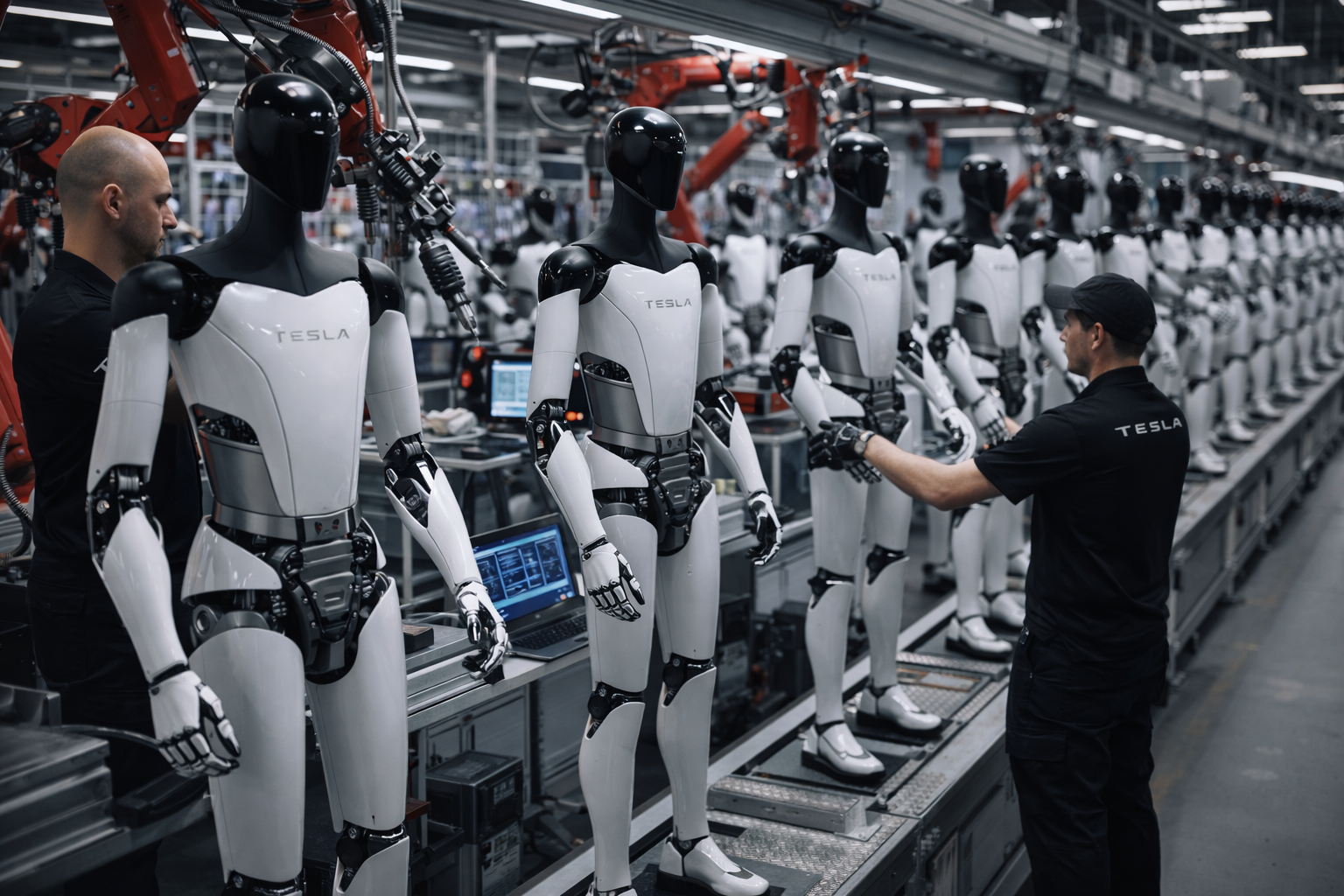
The company is also expected to unveil a new version of its humanoid robot, Optimus, in the coming weeks.
Terafab plan reinforces AI strategy
Over the weekend, Musk announced plans for a semiconductor manufacturing facility known as “Terafab,” to be developed as a joint venture with SpaceX and xAI.
The project is aimed at vertically integrating chip production to support Tesla’s AI ambitions.
Baird analyst Ben Kallo said the initiative aligns with Tesla’s history of vertical integration, referencing its earlier battery manufacturing efforts.
Kallo maintained a Buy rating on the stock with a $548 price target.
Analysts divided on outlook
Wall Street remains split on Tesla’s prospects as the company pivots toward AI-driven growth.
Analyst Trip Chowdhry issued a Sell recommendation, setting a $150 price target for 2026 and arguing that the company’s AI-focused investment thesis has weakened.
He compared Tesla’s trajectory to past technology cycles where expectations outpaced execution.
Meanwhile, Barclays maintained an Equalweight rating with a $360 price target, cautioning that the Terafab project could require significantly higher capital expenditure than currently anticipated.
Analyst Dan Levy said total spending could exceed $100 billion over time, though he noted that bullish investors appear willing to support the investment given its potential strategic importance.
Tesla’s recent gains highlight the continued divergence between its stock performance and underlying automotive trends.
While improving European sales provides some support, investor sentiment is increasingly tied to the company’s ability to execute on its artificial intelligence ambitions.
The post Why Tesla stock is outperforming the broader market today appeared first on Invezz
